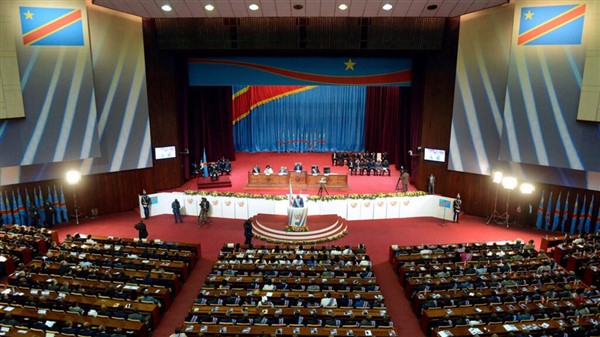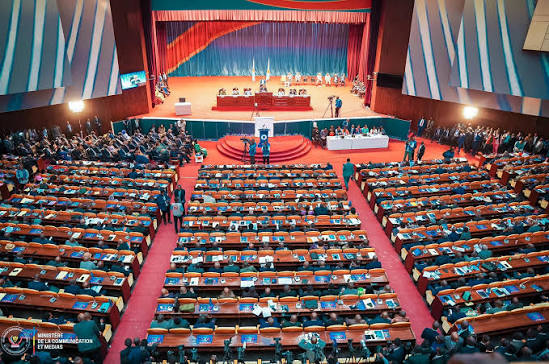
KINSHASA — The National Assembly of the Democratic Republic of the Congo adopted a revised version of the law establishing the conditions for organizing a referendum on Friday, October 23, 2026. Re-examined following observations made by the Constitutional Court, the text received 346 votes in favor out of 347 members of parliament who took part in the vote. One lawmaker abstained, while none voted against it. The adoption has reignited debate over the procedures for a potential public consultation and its implications for the country’s constitutional future.
Thirteen Articles Revised Following the Constitutional Court’s Observations
The reconsideration of the text follows a request by the President of the Republic, Félix-Antoine Tshisekedi Tshilombo, after the Constitutional Court issued its ruling on July 28, 2026.
The High Court had declared the law constitutional while making interpretative reservations concerning thirteen articles. The National Assembly’s Political, Administrative and Legal Committee (PAJ) subsequently reviewed and reformulated those provisions to take the constitutional judges’ observations into account.
The October 23 vote therefore represents another step in the legislative process for this bill, which was introduced in December 2024 by national lawmaker and law professor Paul-Gaspard Ngondankoy.
The text must now continue through the parliamentary process in the Senate before proceeding to the subsequent institutional stages.
A Legal Framework for Organizing Referendums
The stated objective of the law is to clarify the conditions under which a referendum can be organized in the DRC. It addresses, in particular, the framework for public consultation, the procedures for organizing it, and the rules governing the process.
Beyond its technical aspects, the text carries particular political significance, as it comes at a time when the prospect of a possible amendment to the Constitution is dividing political stakeholders in the DRC.
The distinction is essential: establishing rules for organizing a referendum does not mean that a constitutional referendum has already been decided upon, nor that a new Constitution has been adopted. Any potential consultation would depend on the applicable procedures and the required institutional decisions.
Constitutional Reform: Why the Debate Remains Sensitive
Since the bill was introduced, some opposition figures have expressed concerns that the referendum mechanism could potentially be used to amend the 2006 Constitution.
Some opponents, in particular, fear that the adoption of a new Constitution could be used to challenge the limits on presidential terms. However, this concern reflects a political interpretation of the intentions behind and possible consequences of the process; it is not, in itself, proof that such a scenario has been decided upon.
The presidential camp and supporters of the legislation, for their part, emphasize popular sovereignty and the need for a precise legal framework governing the organization of referendums.
The debate therefore concerns both the procedure and the political implications that its implementation could have. To assess the consequences of any potential reform, it will be necessary to examine the specific provisions that might be submitted to a popular vote, the applicable legal safeguards, and compliance with the limits established by the Constitution.
Article 220 at the Center of Concerns
The Congolese Constitution contains provisions under Article 220 that cannot be amended, including those relating to the number and duration of presidential terms.
This protection is central to the debate over possible constitutional reform. Any initiative of this kind would have to be assessed in light of the applicable constitutional provisions and their interpretation by the competent institutions.
The key legal question is therefore how to reconcile the principle of popular sovereignty, referendum mechanisms, and existing constitutional limitations.
The adoption of a law governing the organization of referendums does not, by itself, justify concluding that constitutional reform is inevitable or that a provision protected under Article 220 could automatically be amended.
Next Step Expected in the Senate
Following the National Assembly’s vote, the bill must return to the Senate for the continuation of the parliamentary process. The next stages will help clarify the applicable institutional timetable and the conditions under which the law could enter into force.
For the Congolese people, the key issue will be to monitor not only the progress of the legislative process but also the final content of the text, the safeguards provided to ensure transparency in any potential consultation, and the legal consequences of the provisions ultimately retained.
Ultimately, the October 23, 2026, vote marks progress in the consideration of the referendum law, without meaning that a constitutional referendum has already been scheduled. Debate remains open regarding the implementation of the legislation, the limits on constitutional amendment powers, and the safeguards needed to ensure respect for the Constitution.
Editorial Team