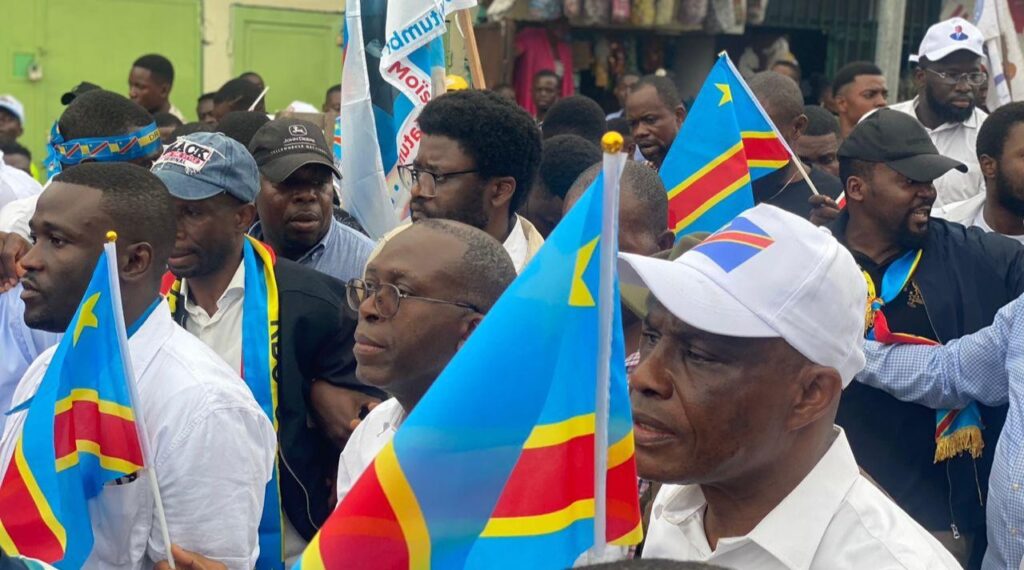
The Congolese opposition is playing a high-stakes game in its standoff with the government. Gathered within the C64 coalition, the anti-Tshisekedi faction has called for a “ghost town” day this Wednesday, June 3, to express their rejection of the proposed referendum law. Opponents view this text as the regime’s first step toward changing the Constitution.
For forces opposed to the current government, this legislative initiative would pave the way for a reconfiguration of the political rules of the game, potentially allowing President Félix Tshisekedi to extend his time at the head of the country. A prospect that opponents say they intend to fight fiercely starting now. “We are asking parents not to let their children go to school, and parents themselves not to go to the market or to work. We are simply going to prove to Mr. Tshisekedi that the people do not agree with his project,” urged Martin Fayulu, the leader of the Ecidé party.
The leaders of the C64 coalition put forward another major argument: the ongoing war in the east of the country. According to them, the current security context does not allow for a calm consideration of organizing a referendum on such a sensitive issue as the “law of laws,” which concerns the future of the nation.
The call to paralyze activities has been echoed by several groups within the coalition. In Kinshasa, the Alliance for Change (A.ch) party, led by Jean-Marc Kabund-a-Kabund, has taken a stand. For its supporters, the adoption of the referendum bill constitutes a red line. Furthermore, they warn that the opposition will react as soon as the text clears the parliamentary stage. Hence, they have reassured, Wednesday’s ghost town is only the beginning of a process of protest intended to prevent any alteration of the current institutional balance.
The battle being waged does not concern only political parties, but all citizens, asserts a mobilizer from Envol. According to a member of Delly Sesanga’s political party, the debate centers on respect for the spirit of the Constitution and the democratic guarantees surrounding the transfer of power at the top of the state.
– Police on the alert –
This show of force is a warning, a way for the opposition to challenge the regime. Savvy observers believe that this bold action is a true full-scale test for an opposition often criticized for its difficulties in mobilizing and getting the population to join its initiatives. After several years marked by scattered actions, the leaders of the C64 are seeking to measure their ability to rally around a common cause.
Facing this rise in political tension, the Kinshasa police are organizing. Deputy Divisional Commissioner Israël Kantu recently met with heads of intervention units and intelligence services to prevent disturbances and, above all, to preserve public order. The instructions are clear: citizens not involved in the protest movements must be free to continue their activities.
The political sequence will not end with this Wednesday. Two days later, on June 5, proponents of constitutional change plan to hold their own show of support on the streets of Kinshasa. Through this mobilization, they intend to defend the idea of constitutional reform as an instrument for development and the consolidation of territorial integrity.
In this context of increasing polarization, the success or failure of the June 3 “ghost town” will be scrutinized closely. More than just a day of protest, it appears to be the first real barometer of the opposition’s ability to mobilize beyond its militant circles and to impose its agenda in the national debate.
By Mputu Patrick/Ouragan.cd


