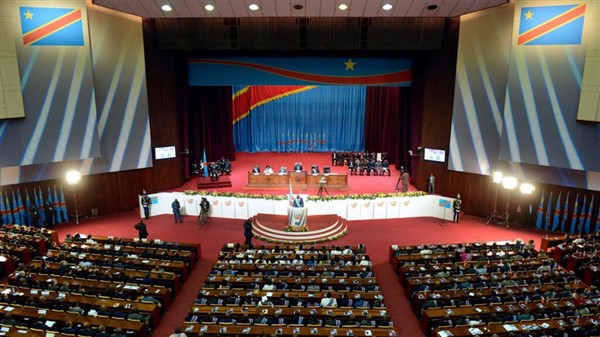
The National Assembly is examining, this Thursday, April 30, the proposed law establishing the conditions for organizing referendums in the Democratic Republic of Congo. This initiative was introduced on December 14, 2024, by Member of Parliament Paul-Gaspard Ngondankoy.
Through this text, its author intends to fill a legal void and adapt the legal framework for referendums to the requirements of the current Constitution.
People’s sovereignty at the heart of the process
In the explanatory memorandum, the MP recalls that Article 5 of the Constitution of the Democratic Republic of Congo enshrines the principle that national sovereignty belongs to the people. This sovereignty is exercised either directly through referendums or elections, or indirectly through elected representatives.
The elected representative from Yahuma in Tshopo also emphasizes the historical significance of this sovereignty, regained after the country’s independence on June 30, 1960, following a long period marked in particular by its confiscation during the one-party state regime.
Incomplete and Outdated Legal Framework
According to the author of the proposal, while elections are well-regulated by law, referendums remain governed by outdated legislation, notably the law of June 2, 2005, adopted during a period of political transition.
This legislation is now considered inadequate, as its primary objective was to facilitate the adoption of the current Constitution. It does not cover all the matters that can be submitted to a referendum, even though the Constitution provides for several.
The member of parliament from the Dynamique Agissons group therefore emphasizes the need to broaden the scope of referendums and clearly define their organizational procedures.
Adapting Procedures and Strengthening the Legal Framework
The proposal also aims to modernize the procedures related to conducting referendums, as well as the rules governing electoral disputes that may arise.
Particular emphasis is placed on strengthening the penal system to guarantee the transparency and credibility of the process.
Furthermore, the text proposes the establishment of a transitional mechanism to adapt certain constitutional rules to the evolving realities of the country, particularly in the political, economic, and social spheres.
Preventing Institutional Deadlocks
According to the bill’s sponsor, this transitional mechanism aims to prevent any paralysis of the state due to the rigidity of certain constitutional provisions.
With the approval of the people, it would allow for smooth adjustments, without resorting to inappropriate constitutional revisions or disruptive solutions.
Towards “Direct Democracy”
Ultimately, this bill aims to organize referendums in the Democratic Republic of Congo in a comprehensive, coherent, and responsible manner.
Considered the second pillar of direct democracy after elections, this mechanism should, according to its author, benefit from a modern and appropriate legal framework to fully implement the constitutional provisions.
Another similar bill was tabled on March 19, 2026, by another member of the majority party, Tony Mwaba.