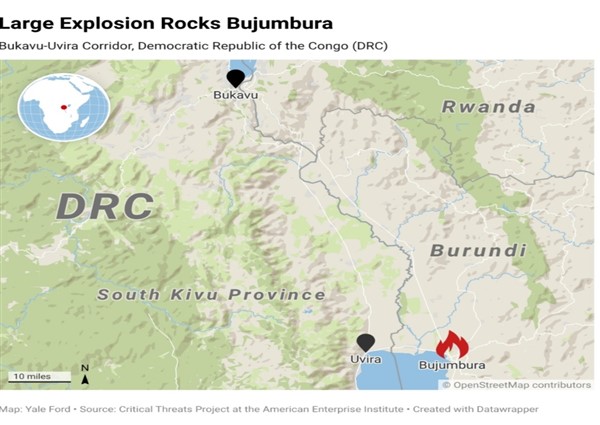
A powerful explosion at a Burundian army (FDNB) weapons depot rocked Bujumbura, Burundi’s largest city and economic capital, located across the border with the Democratic Republic of Congo (DRC). An FDNB weapons depot at a known military site in Bujumbura exploded, affecting several neighborhoods of the city—some more than five kilometers away—for several hours on March 31. The spokesman for the Burundian National Defense Forces (FDNB), Gaspard Baratuza, claimed on March 31 that a fire caused by a “serious electrical accident” in the ammunition storage room had triggered explosions. Unverified reports in Burundian and French media, including Agence France-Presse, indicated that a drone attack or a projectile landing on the stockpile had triggered the explosions. On April 1, Baratuza stated that the incident had resulted in 13 deaths and more than 50 injuries. Burundian media cited unofficial sources on April 1 that 80 people may have perished in the explosion.
The potential destruction of an FDNB base could affect the FDNB’s operations in eastern DRC against the M23. The FDNB is the Congolese army’s (FARDC) most important military ally in South Kivu province. The FARDC uses Bujumbura and its airport, about 16 miles east of the city of Uvira in South Kivu, as a rear base and launching point for FDNB-FARDC military operations against the M23. The FDNB began a partial redeployment of troops to South Kivu via Lake Tanganyika in late December 2025 and early January 2026 after the M23 withdrew from Uvira, with at least 5,000 soldiers remaining by the end of February. The camp is a key logistics base for the FDNB, with several military facilities, a fuel station, and sites for storing weapons and other military equipment, playing a role in supplying the FDNB in eastern DRC. This base reportedly received arms shipments from Tanzania and an unspecified European country intended for use in the DRC in late March before the weapons depot exploded.
By Yale Ford