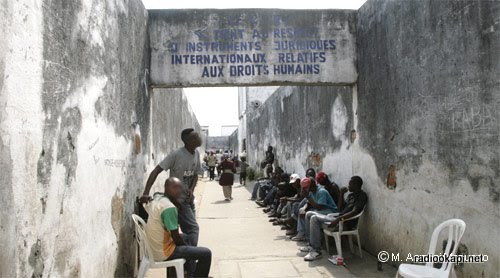
With 16,155 people held in a facility originally designed for just 1,500, Makala Central Prison is facing extreme overcrowding. The Congolese government has decided to temporarily suspend the admission of new inmates, except in duly justified cases. The emergency measure raises a fundamental question: how can prisons be decongested without compromising the administration of justice?
Makala Central Prison in Kinshasa is once again at the center of concerns over detention conditions in the Democratic Republic of the Congo. Faced with increasingly alarming overcrowding, the Minister of State, Minister of Justice and Keeper of the Seals, Guillaume Ngefa Atondoko Andali, has ordered the temporary suspension of new inmate admissions to the facility.
The decision, contained in a circular dated October 21, 2026, and made public the following day, aims to prevent a further deterioration of detention conditions. However, it provides for duly justified exceptions, meaning that the measure does not amount to an absolute or permanent closure of the prison.
16,155 Inmates for 1,500 Places: A Critical Situation
Figures released by the Ministry of Justice illustrate the scale of the problem. Originally designed to accommodate 1,500 people, Makala Prison currently holds 16,155 inmates, including 303 women and 201 children in conflict with the law.
The facility is therefore holding more than ten times its intended capacity. Such a concentration of people in an inadequate space places enormous pressure on infrastructure, food supplies, access to clean drinking water, sanitation and medical services.
During a press briefing held on October 22, Guillaume Ngefa explained that the prison housed approximately 16,000 inmates, while its operating budget had been calculated for a much smaller population. He also highlighted health-related challenges, including cases of cholera and the presence of inmates requiring specialized medical care.
The situation has gone beyond the administrative management of a correctional facility. It raises questions about the state’s ability to guarantee detention conditions that are compatible with human dignity.
An Emergency Decision, but What Happens to Newly Arrested Suspects?
The suspension of admissions is a temporary measure intended to prevent conditions from deteriorating further. However, it raises another challenge: how should authorities manage people arrested or placed in pretrial detention in Kinshasa?
Where will individuals whose detention has been legally ordered be taken if Makala can no longer accommodate them under normal conditions? Do other correctional facilities have enough space to absorb additional inmates? And what safeguards will be put in place to prevent the problem from simply being transferred to other prisons?
These questions require clear answers from judicial and prison authorities. Transferring inmates to other facilities may help ease overcrowding, but it cannot provide a lasting solution if the receiving prisons are themselves struggling with overcrowding.
It is also important to emphasize that the suspension concerns new admissions to Makala. It does not mean that people already detained will automatically be released, nor does it mean that criminal proceedings against suspects will be abandoned.
Pretrial Detention at the Heart of the Problem
Beyond the lack of space, the situation at Makala highlights broader problems within the Congolese criminal justice system. In a report published on October 16, Radio Okapi stated that more than 11,000 people held at Makala were in pretrial detention, according to figures provided at the time by the prison director.
Pretrial detention involves individuals deprived of their liberty while awaiting the outcome of judicial proceedings. It must not be confused with a final conviction.
When cases accumulate, hearings are delayed or judicial decisions take too long, individuals may remain in prison for extended periods without a final judgment. This contributes to overcrowding and raises concerns about the right to be tried within a reasonable time.
Speeding up case processing, regularly reviewing the legality of detention and making use of lawful alternatives where the relevant conditions are met could help reduce this pressure.
However, this does not mean releasing all detainees indiscriminately. Each case must be examined individually, taking into account procedural rules, judicial safeguards, the nature of the case and the rights of victims.
Fundamental Rights Put to the Test by Overcrowding
Being deprived of liberty does not mean losing all one’s rights. Detainees retain, among other protections, the right to human dignity, appropriate medical care and detention conditions that comply with legal requirements.
Extreme overcrowding can undermine access to these safeguards. Lack of space, poor hygiene, inadequate medical resources and the risk of disease transmission particularly affect vulnerable people.
The presence of women and children in conflict with the law calls for heightened vigilance. Their situations must be assessed in accordance with the specific rules applicable to them and, in the case of minors, the principle of the best interests of the child.
Congolese Law No. 23/028 of June 15, 2023, on the fundamental principles governing the prison system, provides a legal framework for the management of correctional facilities and the protection of detainees. The challenge now is to translate these principles into concrete, measurable and sustainable action.
What Solutions Could Bring an End to the Crisis?
The temporary suspension of new admissions can produce lasting results only if it is accompanied by a coherent strategy to reduce overcrowding and reform the prison system.
Measures that could help include:
- Speeding up judicial proceedings: Prioritizing older cases and reviewing those involving individuals whose pretrial detention urgently requires reassessment.
- Individual reviews of possible releases: Identifying people who may legally qualify for provisional release, conditional release or other measures provided for under applicable law.
- Improving medical care for detainees: Conducting health assessments, ensuring access to necessary treatment and referring people to appropriate facilities when the required care cannot be provided in prison.
- Regulated transfers between facilities: Moving some detainees to prisons with genuine available capacity, rather than simply shifting overcrowding elsewhere.
- Improving infrastructure: Investing in sanitation, clean water, healthcare, food supplies and the rehabilitation of existing facilities, while developing suitable additional capacity.
- Strengthening judicial and prison oversight: Regularly monitoring inmate numbers, detention conditions and the effective implementation of court decisions.
The government has announced that efforts to reduce overcrowding will continue, including faster reviews of cases that could result in provisional releases. The actual implementation of these commitments will be crucial in determining the impact of the decision.
A Necessary Measure, but Not Enough on Its Own
By temporarily suspending new admissions to Makala, the authorities are acknowledging the seriousness of a situation that cannot be resolved through simple administrative adjustments. The decision may help prevent overcrowding from worsening, but its effectiveness will depend on the measures that accompany it.
The real challenge is to ensure that prison does not become an additional punishment imposed on people, some of whom are still awaiting trial. An effective prison policy must balance public safety, the requirements of justice and respect for fundamental rights.
Can Makala truly overcome this crisis without a deeper reform of pretrial detention, judicial procedures and prison infrastructure? The answer will depend less on announcements than on the authorities’ ability to turn this emergency measure into tangible results.
Rédaction


