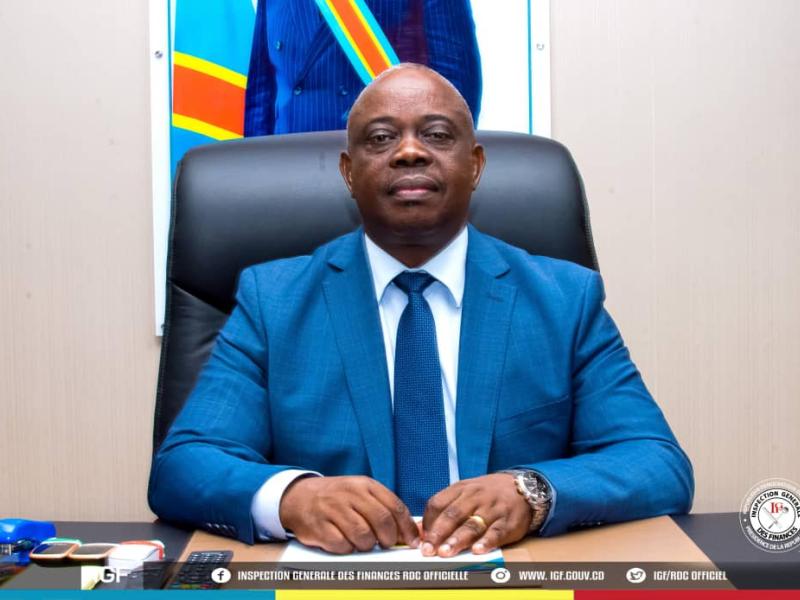
Unlike Jules Alingete, Christophe Bitasimwa Bahii is withdrawing IGF agents from public enterprises and institutions in favor of ex-post monitoring of state financial flows. The IGF risks losing its capacity for early detection of irregularities.
In the Democratic Republic of Congo (DRC), the new strategy of the General Inspectorate of Finance (IGF), headed by Christophe Bitasimwa Bahii (who succeeded Jules Alingete in May 2025), marks a major turning point with the end of permanent “financial patrols.”
IGF inspectors have officially left the public enterprises and institutions where they exercised ex-ante control over the expenditure chain.
Oversight now focuses on analyzing financial flows after transactions are completed, an approach considered more in line with auditing standards but which worries representatives of portfolio companies.
Technical and Strategic Challenges
This new method faces technical hurdles, particularly in maintaining the deterrent effect against corruption without a constant physical presence. To address this, the General Inspectorate of Finance (IGF) adopted a three-year modernization plan in February 2026 and launched an inter-institutional task force in March 2026 with other services such as the Anti-Corruption Agency (APLC) to strengthen financial oversight.
The new strategy of the General Inspectorate of Finance (IGF), as reported in recent analyses by Africa Intelligence, faces several structural and technical challenges.
The main hurdle lies in the withdrawal of agents from public companies and institutions in favor of ex-post oversight of state financial flows.
Indeed, the shift from a physical presence to remote monitoring of financial flows is proving technically complex to implement. By withdrawing from the field within public structures, the IGF risks losing its capacity to detect irregularities early.
Competition and Legitimacy
The IGF is seeing some of its traditional functions gradually taken over by other actors perceived as more legitimate, particularly since the 2022 reform of the senior civil service. Government attempts to strengthen the IGF’s oversight capabilities have been struck down by the Constitutional Council, limiting the expansion of its legal prerogatives. IGF members themselves are expressing doubts about the consequences of the senior civil service reform on the service’s autonomy and missions.
The “sanctuary” effect: By removing its inspectors from the heart of public enterprises, the IGF is creating a void. Without this daily physical presence, public fund managers may feel less scrutinized, which increases the risk of wrongdoing before any warnings can be raised.
Ex-post control often comes too late. Once funds have been disbursed or contracts signed, recovering misappropriated assets or canceling disputed transactions becomes a complex and uncertain legal process.
Technological Dependence
For remote monitoring of financial flows to be effective, the IGF (General Inspectorate of Finance) needs high-performance digital tools for interconnection with banks and the Treasury. However, the deployment of these systems is often hampered by technical delays.
Loss of Professional Expertise: By no longer immersing themselves in the internal workings of institutions, inspectors risk losing a nuanced understanding of the mechanisms specific to each sector (energy, mining, infrastructure), limiting themselves to a purely accounting analysis.
In short, the role shifts from that of a “watchdog” (prevention) to that of a “forensic pathologist” (assessment of damages).
Aimé Binda