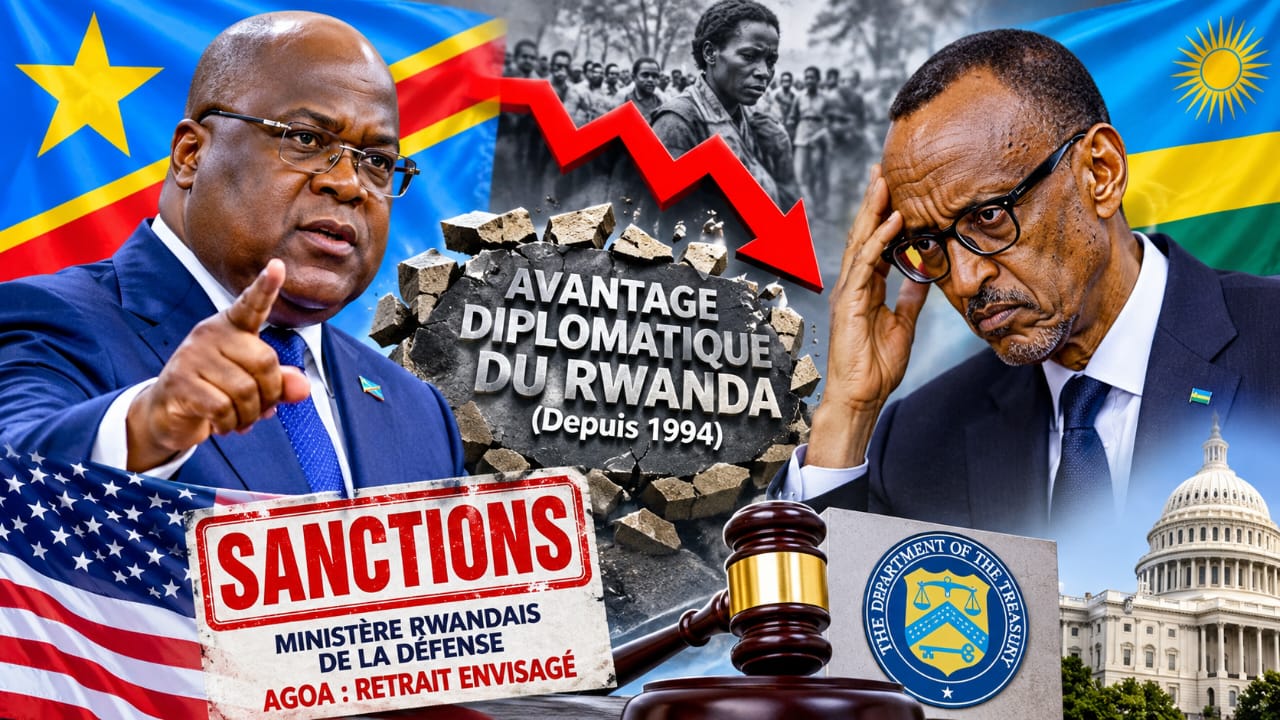
From a favored partner of Washington to a country targeted by US sanctions, Rwanda is seeing the gradual erosion of the diplomatic influence it patiently built following the 1994 genocide. Félix Tshisekedi’s international strategy, which has placed Kigali’s accountability at the heart of the conflict in eastern DRC, is contributing to this shifting balance of power.
KINSHASA — For nearly three decades, Paul Kagame built a special relationship with major Western powers, particularly the United States. In the aftermath of the 1994 genocide, Rwanda received exceptional diplomatic attention. The country’s reconstruction, visible institutional stability, and strategic positioning in international relations gradually turned Kigali into a favored partner for Washington. This relationship was one of the Rwandan regime’s primary diplomatic assets. Paul Kagame had successfully turned the trauma of the genocide and national reconstruction into a powerful lever for international recognition. But today, this advantage appears to be seriously called into question. And in this shift, Congolese diplomacy led by Félix Tshisekedi plays a significant role.
Tshisekedi Has Shifted the Center of Gravity of the Diplomatic Debate
Since taking office, Félix Tshisekedi has progressively made Rwanda’s alleged involvement in destabilizing eastern DRC a central issue of his foreign policy. Kinshasa has intensified outreach to the United Nations, the United States, the European Union, and regional organizations to gain international recognition of Kigali’s role in the Congolese conflict.
This diplomatic offensive has notably involved internationalizing the M23 issue, denouncing the presence of Rwandan forces on Congolese territory, and demanding concrete measures against those allegedly responsible for this destabilization.
The shift is considerable: Rwanda, long presented as an essential partner in Western security policies in Africa, now finds itself forced to answer accusations that directly impact its international standing. The challenge for Kinshasa was no longer simply to denounce aggression, but to challenge the diplomatic advantages Kigali had enjoyed since the post-genocide era.
Washington Moves from Warnings to Sanctions
Developments in recent months illustrate this trend. On October 28, 2026, the US Department of the Treasury announced the freezing of US-based assets of the Rwandan Ministry of Defense and the Zigama Credit and Savings Society cooperative bank, which is suspected of facilitating weapons acquisitions for M23.
In March 2026, Washington had also imposed visa restrictions on several senior Rwandan officials accused of contributing to instability in the Great Lakes region.
However, the most recent political signal came on November 2, 2026. Donald Trump’s administration announced its intention to remove Rwanda from the AGOA (African Growth and Opportunity Act) preferential trade program, effective January 1, 2027.
According to the US Trade Representative, this decision stems notably from concerns regarding trade barriers, the rule of law, human rights, and US national security and foreign policy interests.
Washington is thus establishing a connection between Rwanda’s behavior and the benefits the country enjoyed through its economic relationship with the United States. While the immediate commercial impact of this measure remains relatively limited for Kigali, its political significance is far more substantial: Rwanda is no longer immune to the diplomatic consequences of its regional choices.
The Post-Genocide Diplomatic Legacy Put to the Test
During the two decades following the 1994 genocide, the United States maintained a particularly favorable relationship with Rwanda.
The international community’s historical responsibility for failing to act during the massacre of the Tutsi helped shape this dynamic. The country’s reconstruction and Kigali’s recorded economic successes further reinforced its status as a model partner.
Paul Kagame had thus built a genuine reservoir of trust with several Western capitals. However, the emergence of M23 in 2012, followed by a growing number of international reports documenting Rwandan support for the rebellion, steadily eroded that relationship. The current crisis marks a new stage: accusations against Kigali are no longer merely the subject of diplomatic statements or concerns voiced in international reports. They are now accompanied by economic and individual measures implemented by Washington.
It is precisely this shift that is weakening the diplomatic capital accumulated by Paul Kagame since the end of the genocide.
Félix Tshisekedi’s Diplomatic Gamble
For Félix Tshisekedi, this shift represents a major diplomatic result. By taking the Congolese conflict before major powers, the Congolese president has helped alter international perception regarding the Rwandan issue.
The signing of the Washington Accords in December 2025, driven by Donald Trump, had already marked the direct involvement of the United States in seeking a solution between Kinshasa and Kigali. However, this mediation also created a new political obligation: commitments made must be respected by both parties. When Washington considers that Kigali is not honoring its commitments, the repercussions can now directly affect its diplomatic and economic interests. Nonetheless, it would be an overstatement to attribute all US sanctions solely to Félix Tshisekedi’s actions. Washington’s decisions also align with its own strategic, economic, and security interests in the region, particularly regarding Congolese mineral resources. Congolese diplomacy has, however, contributed to creating the political conditions under which these American interests align with Kinshasa’s demands.
A Historic Reversal, But Not Yet a Final Victory
The contrast is striking. Yesterday, Rwanda was considered an indispensable strategic partner of the West. Today, its Ministry of Defense faces US sanctions, some of its officials are targeted by visa restrictions, and its access to a preferential trade program is scheduled to end.
Nevertheless, Kigali retains international relations, economic partners, and diplomatic leverage. US sanctions do not equate to the total isolation of Rwanda.
Furthermore, Kinshasa’s credibility will also depend on its ability to honor its own commitments, particularly regarding the neutralization of the FDLR, and to secure tangible progress on the ground. The real question now is whether Félix Tshisekedi will manage to convert this new diplomatic momentum into lasting peace in eastern DRC.
One thing appears clear: the capital of trust Paul Kagame enjoyed with Washington for decades is now undergoing a major test. And Félix Tshisekedi’s diplomacy has played a key role in placing this issue at the center of international relations in the Great Lakes.
Roger Lazio


