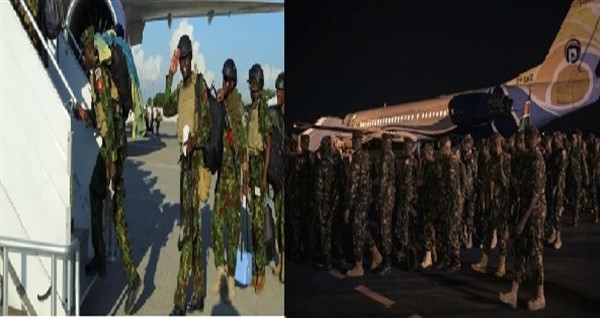
It feels like déjà vu. After two years in Haiti, the last Kenyan police officers left Port-au-Prince this Monday. While the official narrative attempts to maintain appearances, the reality on the ground is undeniable: the Multinational Security Support Mission (MMSS) has resulted in a record of failure reminiscent of the Kenyan withdrawal from eastern DRC at the end of 2023.
A Record Tinged with Powerlessness
Deployed in June 2024 under a UN mandate, the Kenyan force had the monumental task of breaking the stranglehold of the gangs that are suffocating the Haitian capital. Nearly two years later, the assessment is bleak. Despite the very localized security measures at the airport and on a few roads, the gangs still control nearly 80% of Port-au-Prince. Worse still, the violence has metastasized. According to UN data, armed groups have taken advantage of the force’s ineffectiveness to extend their control to the city’s outskirts. The human cost is staggering: more than 5,000 people lost their lives between March 2025 and January 2026. Among these victims, 3,000 died during operations conducted by security forces, raising questions about the brutality and lack of precision of these interventions. The DRC’s shadow: A specialty of “withdrawal without results”?
For international observers, this hasty departure echoes the Kenyan experience in the Democratic Republic of Congo. At the end of 2023, Kenyan troops, deployed under the banner of the East African Community (EAC), had to leave North Kivu amid fierce criticism from the Congolese government and the population. At the time, they were criticized for a form of passivity in the face of the M23 rebels, even for an ineffective “coexistence.”
In Haiti, the scenario seems to have repeated itself: an under-equipped, under-funded force (operating at only 40% of its capacity, according to President William Ruto), and incapable of moving from a static guard posture to a real offensive against criminal organizations. Added to this is the disgrace: the UN has upheld accusations of sexual abuse, particularly against minors, definitively tarnishing the Nairobi police force’s record.
The next generation: Chad on the front line?
The departure of the Kenyans leaves a security vacuum that the international community is trying to fill by changing its strategy. The “support” mission is giving way to a more robust structure: the Anti-Gang Force.
This new entity aims to field 5,500 members in the hope of shifting the balance of power. The key points of this rotation are as follows:
- The massive deployment from Chad: N’Djamena has already pledged to send 1,500 troops. Chadian soldiers are renowned for their urban combat experience and their effectiveness in the fight against terrorism in the Sahel, a profile that contrasts sharply with that of Kenyan police officers.
- Transformation into a peacekeeping mission: Faced with the chronic lack of funding denounced by Kenya, advanced discussions at the UN Security Council aim to transform this multinational force into a genuine peacekeeping operation (blue helmets). This would ensure sustainable funding through the UN budget, something the Kenyan mission sorely lacked.
- The integration of new contributors: In addition to Chad, other nations (particularly Caribbean and West African countries) are being approached to reach the target of 5,500 troops.
The Kenyan withdrawal marks the end of an illusion: that a light police force could defeat heavily militarized gang armies. As the last officers depart Nairobi, they leave behind a country still engulfed in violence, and a Haitian population wondering whether the next foreign force will finally be the right one, or if it will simply prolong a cycle of fruitless interventions.
Aimé Binda