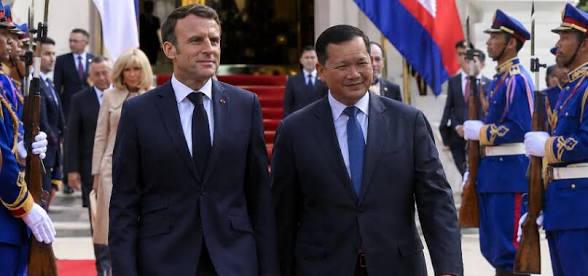
Sent overnight between November 12 and 13, 2026, Emmanuel Macron’s letter argues for the withdrawal of the outgoing Secretary-General “for the good of the OIF” (Organisation internationale de la Francophonie). Paris wants to avoid holding a vote scheduled for Monday, November 16, viewing the election as a source of deep division within the institution.
According to Jeune Afrique, the French head of state proposes clearing the path for former Romanian Prime Minister Dacian Cioloș. To achieve this, Emmanuel Macron indicates that Congolese President Félix Tshisekedi and Mauritanian President Mohamed Ould Ghazouani would also be willing to withdraw their respective candidates, Juliana Amato Lumumba and Coumba Ba.
The French president suggested that the announcement of Louise Mushikiwabo’s withdrawal take place before the ministerial conference scheduled in Phnom Penh on Saturday, November 14, 2026.
The Diplomatic Context and the DRC’s Threat
As early as November 7, 2026, the Democratic Republic of the Congo (DRC) threatened to leave the OIF if the former Rwandan Minister of Foreign Affairs were re-elected. Against a backdrop of heightened tensions between Kinshasa and Kigali, the Élysée Palace has been working actively since late October to prevent the exit of the world’s largest French-speaking country by number of speakers.
Before requesting this joint withdrawal, Paris had considered a candidacy by former Senegalese President Macky Sall, an option that was quickly ruled out. France had subsequently raised the possibility of postponing the election by one to two years, a solution deemed formally impossible under the current rules of the process.
Initial Reactions
On Friday, November 13, 2026, the outgoing Secretary-General reaffirmed her desire for the election to go ahead as planned on November 16. She publicly refuses to consider withdrawing her bid for re-election.
While awaiting a response from Kigali, Rwandan President Paul Kagame had not yet replied to Emmanuel Macron’s message.
With JA