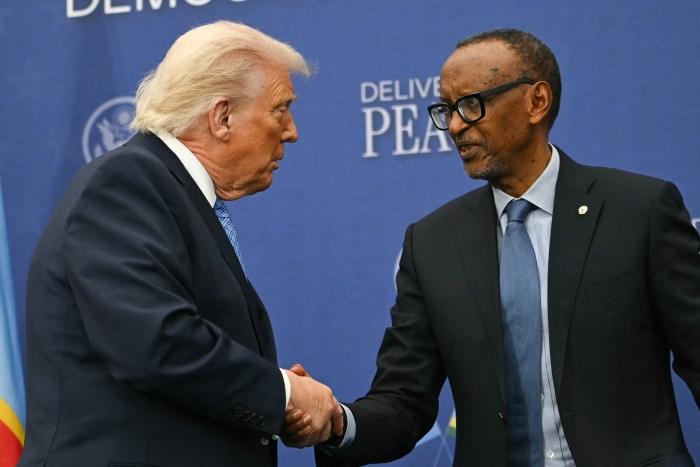
Conflict in Eastern DRC: Washington multiplies measures against Kigali, accused of supporting M23 in violation of its commitments in the Washington Accords.
KINSHASA – Paul Kagame’s Rwanda is facing growing pressure from Donald Trump’s U.S. administration. Following the sanctions announced on October 28, 2026, against the Rwandan Ministry of Defense and a financial institution linked to the country’s security services, Washington is now considering removing Kigali from the American AGOA preferential trade program, effective January 1, 2027.
This new decision, announced on November 2 by U.S. Trade Representative Jamieson Greer, marks a further hardening of relations between Washington and Kigali. It comes amidst persistent clashes in the eastern Democratic Republic of the Congo and U.S. accusations regarding Rwanda’s involvement in providing military support to the M23 rebel movement.
The Washington Accords Put to the Test of Actions
The central issue is now the respect of commitments made by Kigali under the Washington Accords for peace and prosperity, signed on December 4, 2025, by Presidents Félix Tshisekedi and Paul Kagame, under the auspices of the United States.
These agreements specifically aim to end hostilities, respect the territorial integrity of the DRC, and establish conditions for lasting peace in the Great Lakes region. They also provide for the implementation of a mechanism to disengage forces and lift Rwandan defensive measures, alongside the neutralization of the FDLR by the Congolese side. However, the accusations leveled by Washington against Rwanda directly question the implementation of these commitments.
In its October 28 press release, the U.S. Department of the Treasury claims that the Rwandan Ministry of Defense directed the deployment of thousands of Rwandan Defence Forces (RDF) troops in the North Kivu and South Kivu provinces, where they allegedly operate alongside M23.
Washington also accuses Kigali of providing this rebellion with military equipment, weapons, logistical support, and training.
While these accusations originate from the U.S. government, they raise a fundamental question: how can lasting peace between Kinshasa and Kigali be achieved if commitments to withdraw forces and cease support for armed groups are not effectively respected?
The Rwandan Ministry of Defense Directly Sanctioned
The U.S. measure of October 28 goes beyond mere diplomatic statements. The U.S. Treasury officially placed the Rwandan Ministry of Defense on its sanctions list, alongside the Zigama Credit and Savings Society, a Rwandan financial institution described by Washington as playing a role in funding military activities and support for M23.
According to U.S. authorities, this institution facilitated payments linked to the acquisition of military equipment and financial transactions benefiting the rebel movement. Washington also asserts that minerals originating from M23-controlled areas in eastern Congo are being integrated into Rwandan supply chains.
For the Trump administration, these measures aim to compel Kigali to end its support for M23 and withdraw its troops from Congolese territory.
AGOA: A New Pressure Lever Against Kigali
As if financial sanctions were not enough, Donald Trump is now considering another measure that could affect Rwanda’s economic interests. The AGOA (African Growth and Opportunity Act) program offers eligible African countries preferential access to the U.S. market, notably through duty-free access for thousands of products.
Washington’s intention to remove Rwanda from this framework starting January 1, 2027, is part of a broader review of U.S. trade relations with several African partners. To justify its decision regarding Kigali, the U.S. administration cites concerns related to human rights, political pluralism, the rule of law, workers’ rights, trade barriers, and U.S. national security and foreign policy interests.
Even though the AGOA decision does not rely exclusively on the Congolese conflict, its announcement comes on the heels of sanctions tied to Rwanda’s alleged role in the security crisis in eastern DRC. This series of measures adds an economic dimension to the diplomatic and security pressure being exerted on Paul Kagame’s government.
Kigali Facing Its Commitments to Kinshasa
The situation leaves Rwanda facing a delicate diplomatic equation. On one hand, Kigali maintains that it remains willing to implement the Washington Accords, while demanding that the DRC also fulfill its own commitments, particularly regarding the neutralization of the FDLR. On the other, U.S. authorities believe that Rwandan support for M23 and the presence of Rwandan troops on Congolese soil constitute major obstacles to implementing the peace process.
Rwanda denies accusations of supporting armed groups and defends its security posture against the threat posed by the FDLR. However, this position does not erase the requirements outlined in bilateral commitments.
For Kinshasa, the latest U.S. decisions represent a significant development regarding the ongoing aggression and instability in the eastern part of the country.
Will Washington Move from Sanctions to More Binding Measures?
Beyond the announced AGOA exclusion and sanctions against the Rwandan Ministry of Defense, one question remains: how far is Donald Trump prepared to go to obtain the effective implementation of the agreements he helped bring to fruition?
The credibility of the Washington process now faces a concrete test: the withdrawal of Rwandan forces, the cessation of all support to M23, and the restoration of Congolese state authority in the affected territories.
For the DRC, the stake is no longer just about signing new diplomatic commitments. It is about transforming peace promises into verifiable actions on the ground.
— Editorial Team