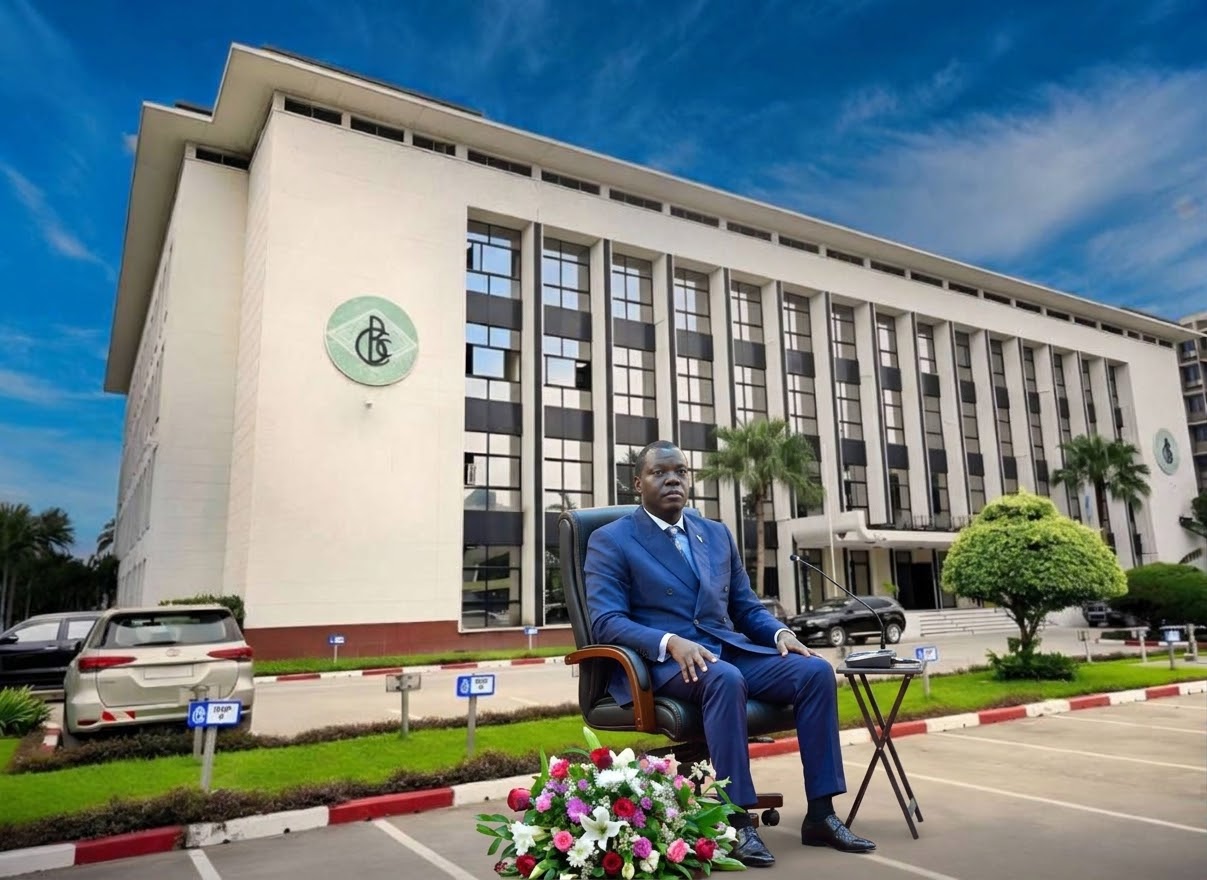
KINSHASA — The gradual publication of financial documents and statements by Africa Intelligence has raised fresh questions about the channels through which the Congolese state makes payments and the circulation of sensitive information within public institutions. At the centre of this unfolding controversy is the Central Bank of Congo (BCC), whose governor, André Wameso, could come under pressure, although nothing currently establishes his responsibility for the alleged leak.
On October 21, 2026, Africa Intelligence published an investigation claiming that President Félix Tshisekedi’s travel and official missions cost at least $122.3 million in 2025, according to documents the media outlet says it reviewed. This amount would represent nearly 33% of the revised budget allocated to the Congolese presidency.
Furthermore, according to the same documents, the mission expenses of Félix Tshisekedi’s wife, Denise Nyakeru Tshisekedi, reportedly amounted to approximately $5.37 million.
These figures are intensifying pressure on the Congolese executive amid recurring criticism over the management of public funds in the Democratic Republic of Congo (DRC), particularly the excessive size of the head of state’s cabinet, which officially employs more than 1,018 staff members. This team includes the chief of staff, several deputy chiefs of staff, dozens of special advisers, senior advisers assigned to various departments, as well as roving ambassadors and special envoys.
Beyond the political cabinet itself, the broader institution of the Presidency of the Republic oversees a total of 31 separate services. Collectively, these services employ nearly 8,000 people, with approximately 7,934 staff members on record.
According to the same documents reviewed by Africa Intelligence, the administrative and operational management of the presidential establishment entails an annual cost exceeding $40.5 million.
It is worth noting that the Democratic Republic of Congo was represented at the United Nations General Assembly by Prime Minister Judith Suminwa rather than President Félix Tshisekedi. No official explanation had been provided for the president’s absence. However, Radio France Internationale (RFI) reported that Félix Tshisekedi was unable to travel without his bodyguards because of US restrictions.
On October 26, the same media outlet published another report focusing on payments from the public Treasury to Marthe Kasalu, the president’s mother, as well as to several foundations linked to the presidential family, including the Marthe Kasalu Foundation and the Étienne Tshisekedi Foundation.
Established in April 2021 by the president’s mother, Marthe Kasalu Jibikila, the Kasalu Foundation officially presents itself as a philanthropic organisation operating in the social, educational and cultural sectors. Although its statutes state that it receives no public subsidies and relies on private donations, the investigation indicates that it benefited from substantial direct transfers from the public Treasury through the Central Bank of Congo, the National Institute for Professional Training (INPP) and the National Fund for Social Protection (FNPSS).
Beyond the president’s mother, other foundations and organisations associated with his brothers, First Lady Denise Nyakeru and the president’s children have also come under scrutiny over questions surrounding the transparency of their funding.
According to civil society groups, these family foundations may serve as a legal façade to conceal the misappropriation of public funds. This financial controversy is now closely linked to international judicial investigations. Belgian authorities are reportedly taking a keen interest in the financial flows involving Félix Tshisekedi’s inner circle, amid suspicions that state funds and revenues allegedly derived from the exploitation of mining resources in Katanga may have ended up in private accounts in Europe.
These successive revelations have brought the issue of public fund traceability, the identity of beneficiaries and the procedures governing the payments in question back to the forefront.
They also raise a sensitive question, should the documents prove authentic: How did financial documents described as internal records reach a specialised media outlet?
An insider yet to be identified?
The release of this information has fuelled speculation that documents may have been passed on by someone with privileged access to financial data. However, the identity of any potential informant, their institution of origin and the circumstances surrounding the alleged transmission have not been publicly established. It would therefore be premature to conclude that there is a “mole” within the Central Bank of Congo.
Moreover, on October 21, the Central Bank publicly denied being the source of the figures relating to the president’s travel budget. In its statement, the institution said it had neither produced nor published an official report containing those figures and called for their origin to be clarified.
This clarification does not, in itself, identify the source of the documents reviewed by Africa Intelligence. Nevertheless, it complicates the question of their institutional origin.
André Wameso on the verge of being ousted?
For André Wameso, who was appointed governor in 2025, the issue now centres on institutional credibility and the ability to control the circulation of sensitive information. If the documents did indeed originate from an internal channel, questions could arise regarding procedures governing access to, storage of and protection of financial data.
Could Wameso face political consequences from this controversy even if he was not personally involved in transmitting the documents? Such a scenario is conceivable, but no verified public information currently supports the claim that his removal is being considered or that a replacement decision is imminent.
It is also important to distinguish a potential failure to protect data from personal responsibility for disclosing it. The two are not automatically equivalent.
Beyond the governor’s fate, this controversy raises a broader question about transparency in the management of public funds in the DRC: Will the authorities provide detailed explanations of the payments in question and the oversight mechanisms governing them?
As further publications may emerge, attention will remain focused on three key issues: the authenticity and precise scope of the documents, the identification of their source, and any official responses.
The next developments in this case will depend on these verifiable elements rather than on speculation alone surrounding the alleged leak.
Editorial Team

