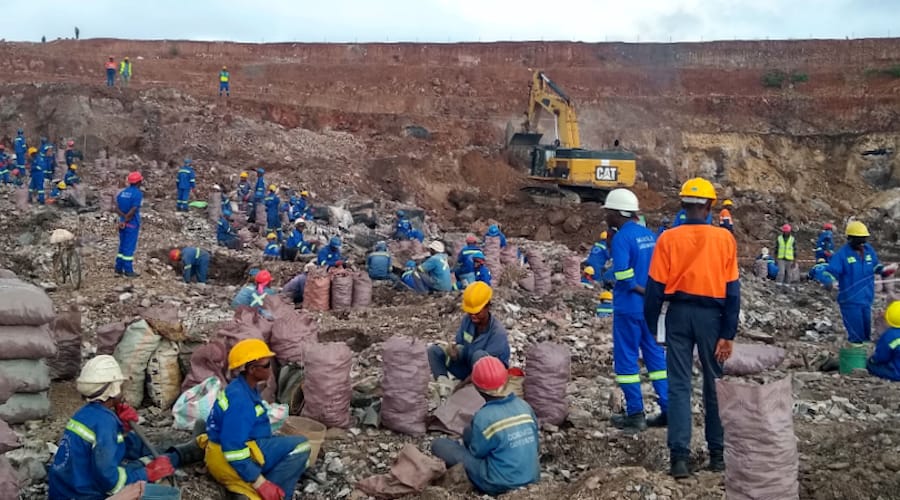
Kisenge manganese, gold, and cassiterite permits; the Mutoshi copper-cobalt and germanium processing project; Sokimo’s four gold permits; Cominiere’s lithium permits; and Sakima’s coltan, gold, and wolframite assets.
<span;>
<span;>The DRC is offering manganese, copper, cobalt, and lithium to the United States.
<span;>The Democratic Republic of Congo has submitted a verified list of mining and processing projects open to American investment to the United States. This represents Washington’s most concrete move to date to reduce China’s stranglehold on critical minerals.
<span;>The shortlist, delivered to U.S. officials last week, includes the Kisenge manganese, gold, and cassiterite permits; Gécamines’ Mutoshi copper-cobalt project and a germanium processing venture; Sokimo’s four gold permits; Cominiere’s lithium permits; and Sakima’s coltan, gold, and wolframite assets.
<span;>These projects are intended for review by American investors under a mining partnership and mark tangible progress in transforming peace and investment talks with the Congo into a lever of influence over its supply chains, according to sources.
<span;>This move follows a December 4 agreement that grants U.S. companies privileged access to Congo’s vast reserves of copper, cobalt, lithium, and tantalum—materials essential for electric vehicles, defense systems, and advanced electronics. Congo is the world’s second-largest copper producer and the top supplier of cobalt, a metal indispensable for battery manufacturing.
<span;>A Turning Point
<span;>This renewed focus on securing foreign supplies comes as U.S. metals policy reaches a decisive turning point, according to analysts. BMO analysts Helen Alamos and George Heppel noted that President Trump’s reaffirmation of the Monroe Doctrine within the framework of the U.S. National Security Strategy marks a shift in how markets value future U.S. metal stockpiles.
<span;>According to them, investors are increasingly betting that the significant volumes of metals accumulated by the U.S. over the past year—particularly copper—will soon be released onto the market. This is expected to ease supply tensions elsewhere and drive down prices. However, analysts warn against the idea that a reduction in stocks is inevitable, as inventories could continue to grow in the coming months and years, potentially reaching levels comparable to those of the Cold War.
<span;>”The trajectory of U.S. metal stocks from here is likely the most important debate for the metals sector today,” Alamos and Heppel stated, noting that Trump’s second term has already seen the largest increase to date in copper stocks, followed by platinum and palladium.
<span;>Congolese officials stated that the list underwent several internal verifications and represents the most direct offer Kinshasa has ever made to Washington.
<span;>China’s Grip
<span;>Chinese companies such as CMOC, Zijin, and Huayou dominate copper and cobalt production in the DRC, where these metals are often mined together. Historically, American companies have stayed away due to conflict, corruption, and logistical hurdles.
<span;>Kinshasa hopes that American capital can mitigate this dominance after years of Chinese expansion. In 2007, Congo granted Chinese mining companies tax breaks until 2040 in exchange for $9 billion in promised investments (of which about $6 billion materialized), while Western governments showed little inclination to limit sales to Chinese buyers.
<span;>By the time U.S. President Donald Trump returned to power in January 2025, Chinese companies controlled approximately 80% of Congo’s mining production, including Tenke Fungurume—once American-owned and now the world’s second-largest source of cobalt, operated by CMOC.
<span;>This mining deal is part of a broader, U.S.-brokered peace agreement between Congo and neighboring Rwanda, aimed at ending decades of violence in eastern Congo. Under the terms of the Washington accords, the U.S. will help oversee a regional peace process in exchange for Congo facilitating American investment, despite ongoing fighting in certain parts of the country.
<span;>Washington has identified 60 critical minerals essential to technologies ranging from weapons systems to wind turbines and semiconductors—many of which are primarily supplied by China. The administration has argued that securing alternative supply sources is a strategic priority.
<span;>
<span;>Cécile
<span;>
The Shortlist of Minerals the DRC Has Handed to Trump