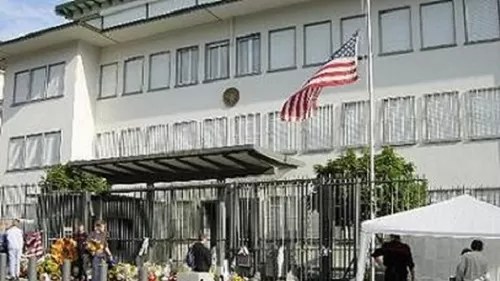
Since May 18, 2026, the U.S. Department of State has suspended all visa services at the U.S. Embassy in Kinshasa, and Congolese authorities are now petitioning Washington to resume visa issuance, Africa Intelligence reported.
This measure implemented by the U.S. Department of State affects all visa categories, whether for immigration or temporary stays (tourism, business, study, or exchange programs). The same restriction applies simultaneously to the U.S. embassies in Kampala (Uganda) and Juba (South Sudan).
This decision follows the WHO’s declaration of a Public Health Emergency of International Concern linked to the Bundibugyo Ebola outbreak in Ituri province. Although Ituri is located in the east of the country, far from Kinshasa, Washington applied a nationwide precautionary principle.
Ongoing Diplomatic Efforts Led by Kinshasa
Kinshasa is officially asking Washington to reopen its consular services, emphasizing the geographical distance between the Congolese capital and the epicenter of the epidemic. Faced with the continuation of restrictions since May 18, Congolese authorities are stepping up their advocacy with Washington to secure a targeted lifting of the suspension in Kinshasa, underscoring the geographical isolation of the outbreak zone.
Geographical Distance and Health Containment
The Congolese capital is located in the far west of the country, nearly 3,000 km by road from Ituri province (in the northeast), where the Bundibugyo Ebola outbreak is concentrated.
Authorities highlight strict controls at internal borders, notably the mandatory 21-day quarantine introduced on June 24 for anyone leaving the affected provinces (Ituri, North Kivu, South Kivu, and Kisangani) prior to any domestic or international travel.
Economic and Human Impact
This prolonged suspension is paralyzing business travel, academic exchanges, and family reunifications between the two countries, even though Kinshasa has recorded no cases linked to this outbreak. Despite these efforts, Washington remains inflexible for now. On November 10, 2026, the U.S. CDC extended for an additional 30 days the entry ban into the United States for any foreign national who has been in the DRC within the past 21 days. Since November 3, 2026, every passenger boarding an international flight bound for the United States must sign an attestation certifying that they have not traveled to the DRC during the preceding 21 days.
The initiative consists of an official diplomatic request launched by the Congolese government (through the Ministry of Foreign Affairs and the DRC’s diplomatic mission in the United States) to the U.S. Department of State and the U.S. Embassy in Kinshasa.
Rather than waiting for the total eradication of the epidemic in the east of the country, the DRC is calling for a differentiated approach. The objective is to decouple the health situation in the capital (in the west) from that of Ituri province (in the far northeast). Congolese authorities are relying on Kinshasa’s epidemiological record (the absence of active clusters) and the health screening mechanisms already in place at airports and internal borders to reassure Washington that there is no risk of transmission from the capital.
The total suspension of visas (tourism, business, study, and immigration) has blocked exchanges between the two countries for six months.
Preserving Consular Hub Status
During the reorganization of the U.S. consular map in Africa in June 2026, Kinshasa was among the 20 posts retained as regional visa processing centers. Congolese authorities are therefore seeking the effective reactivation of this service before this prolonged suspension causes lasting harm to Congolese business operators and students.
Rédaction